
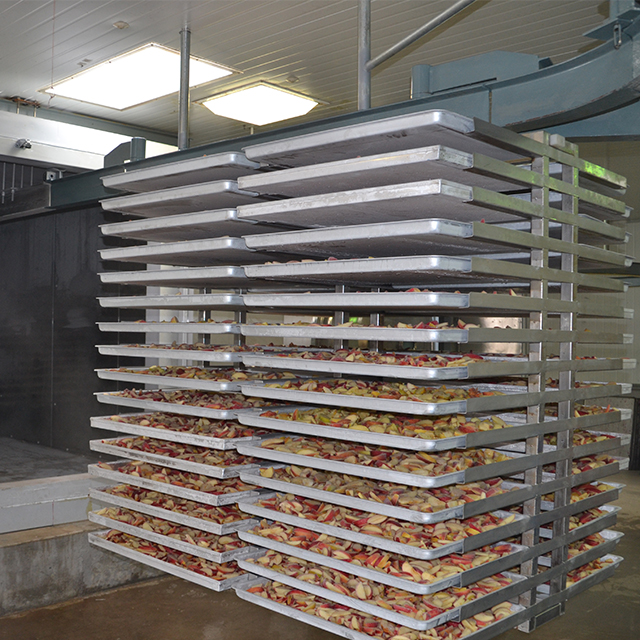
In the design and operation of pharmaceutical freeze dryers, the balance between shelf area and condenser capacity is one of the most critical performance determinants. These two parameters directly influence drying efficiency, product quality, and energy consumption. Understanding how they relate allows process engineers to properly size and operate freeze dryers for both laboratory and industrial production.
Understanding Shelf Area and Condenser Capacity
Shelf Area represents the total heated surface available for holding product containers (such as vials, ampoules, or trays). It defines the potential batch size — the greater the shelf area, the more product can be processed at once. Shelves are temperature-controlled and supply the heat required for sublimation and desorption during freeze drying.
Condenser Capacity, on the other hand, defines how much water vapor the condenser can capture and freeze during the drying process. It is typically measured as ice-holding capacity (kg or liters of ice) or condensing rate (kg/hour). The condenser operates at very low temperatures, usually between –50°C and –85°C, to ensure effective vapor trapping and to protect the vacuum pump.
The Relationship Between Shelf Area and Condenser Capacity
The relationship between these two parameters must be balanced. A freeze dryer with a large shelf area but insufficient condenser capacity cannot effectively remove the sublimated vapor, leading to unstable chamber pressure and longer drying times. Conversely, an oversized condenser adds unnecessary cost and energy consumption without improving performance.
A general engineering ratio often applied is:
1 m² of shelf area = 20–30 kg of ice capacity in the condenser
However, this value should be adjusted according to the specific product load, moisture content, fill depth, and desired cycle time.
Why Balancing Matters
1. Process Efficiency
If the condenser cannot handle the vapor generated during primary drying, vapor will back up into the chamber, increasing system pressure. This reduces the driving force for sublimation, lengthening cycle time and lowering throughput.
2. Product Quality
An overloaded condenser can cause vapor reflux or pressure fluctuations that compromise product structure. This can lead to cake collapse, melt-back, or non-uniform residual moisture, all of which reduce final product stability and shelf life.
3. Equipment Protection
When the condenser is undersized, excess vapor may reach the vacuum pump, contaminating pump oil and damaging components. Proper sizing ensures stable operation and minimizes maintenance.
4. Energy and Cost Efficiency
Over-sizing the condenser increases capital costs and energy usage. Each additional kilowatt of refrigeration capacity translates into higher operating expenses. Therefore, the condenser should be sized for peak load plus a safety margin, not excessively beyond it.
Practical Design Guidelines
| Design Factor | Recommended Practice | Engineering Considerations |
|---|---|---|
| Shelf Area to Condenser Ratio | 1 m² : 20–30 kg ice capacity | Adjust depending on moisture content and heating rate |
| Condenser Temperature | –70°C to –85°C | Lower temperatures trap vapor more effectively |
| Safety Margin | 20–30% above calculated load | Ensures stability under variable product conditions |
| Vacuum Pump Protection | Install vapor baffles or traps | Prevents oil contamination and mechanical failure |
| Process Monitoring | Use Pirani and capacitance gauges | Detects condenser overload and vapor backflow in real time |
Example Calculations
-
Laboratory Freeze Dryer
-
Shelf area: 0.5 m²
-
Recommended condenser capacity: 10–15 kg ice
-
-
Pilot Freeze Dryer
-
Shelf area: 2 m²
-
Recommended condenser capacity: 40–60 kg ice
-
-
Production Freeze Dryer
-
Shelf area: 20 m²
-
Recommended condenser capacity: 400–600 kg ice
-
These examples assume typical pharmaceutical formulations with 85–90% water content and moderate drying rates. Products with higher solids content or aggressive heating profiles may require proportionally larger condensers.
Consequences of Improper Sizing
| Situation | Common Problems |
|---|---|
| Condenser Undersized | Long drying cycles, incomplete sublimation, higher residual moisture, vacuum instability |
| Condenser Oversized | Higher capital and operating cost, inefficient energy use, unnecessary refrigeration load |
| Incorrect Ratio | Non-linear scale-up results, poor reproducibility between pilot and production dryers |
How to Optimize the Ratio in System Design
-
Determine Total Water Load
Calculate total water to be removed per batch based on product mass and moisture content. -
Estimate Peak Sublimation Rate
Use small-scale data or literature to find the maximum expected vapor generation rate during primary drying. -
Design for Peak Plus Margin
Multiply the peak sublimation rate by 1.2–1.3 to define the required condenser throughput. -
Match Refrigeration Power
Ensure that the condenser’s refrigeration system can maintain set temperature even under peak load. -
Validate During Trial Runs
Measure chamber pressure stability and condenser frost formation to verify adequacy during actual operation.
Application in Pharmaceutical and Biotech Freeze Dryers
For pharmaceutical manufacturers, particularly those producing injectable products, biologics, and vaccines, matching shelf area to condenser capacity is essential for cGMP compliance and process robustness.
Modern lyophilizers often include automated control systems that monitor condenser load and adjust shelf temperature accordingly. This integration helps maintain a stable pressure gradient, ensuring consistent product drying across all vials and trays.
Summary
-
Shelf area determines the production capacity of a freeze dryer, while condenser capacity determines its vapor-handling ability.
-
An optimal ratio ensures efficient sublimation, consistent product quality, and reliable vacuum performance.
-
The recommended rule of thumb is 20–30 kg of ice capacity per 1 m² of shelf area, adjusted based on process specifics.
-
Proper balance reduces cycle time, minimizes risk of product defects, and improves energy efficiency.